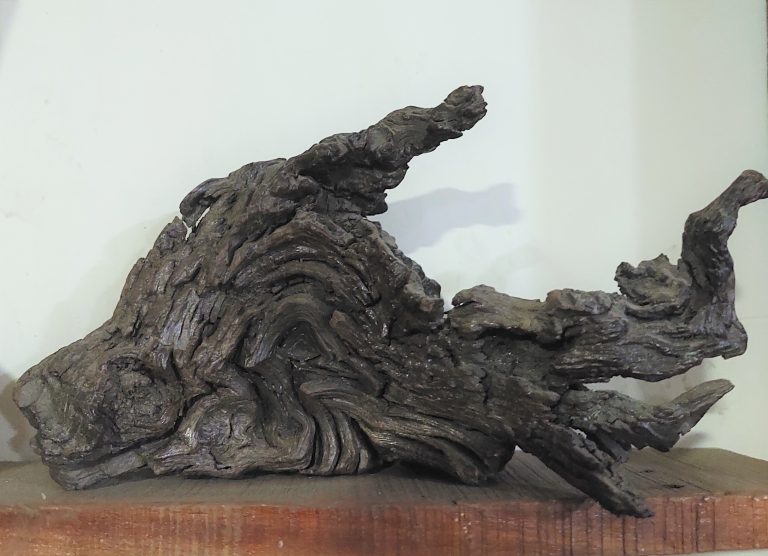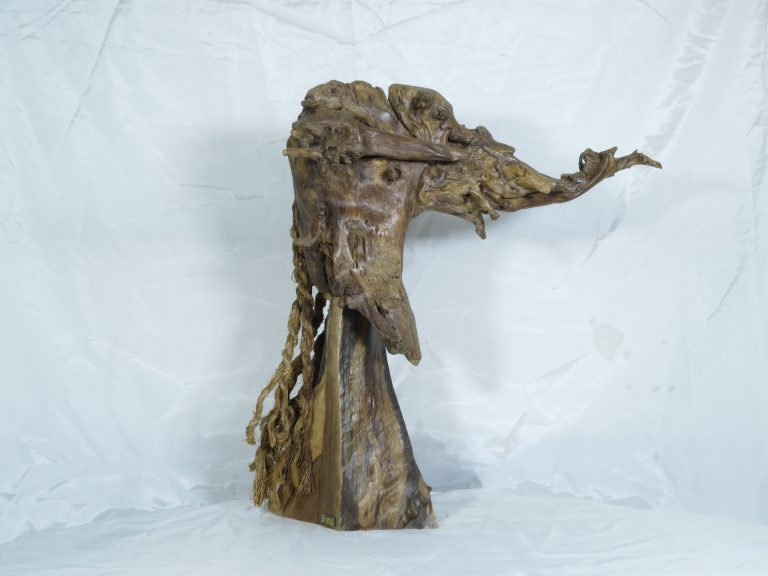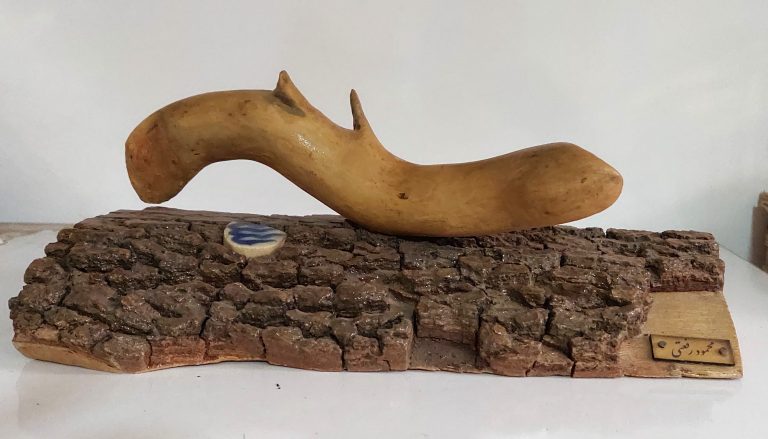
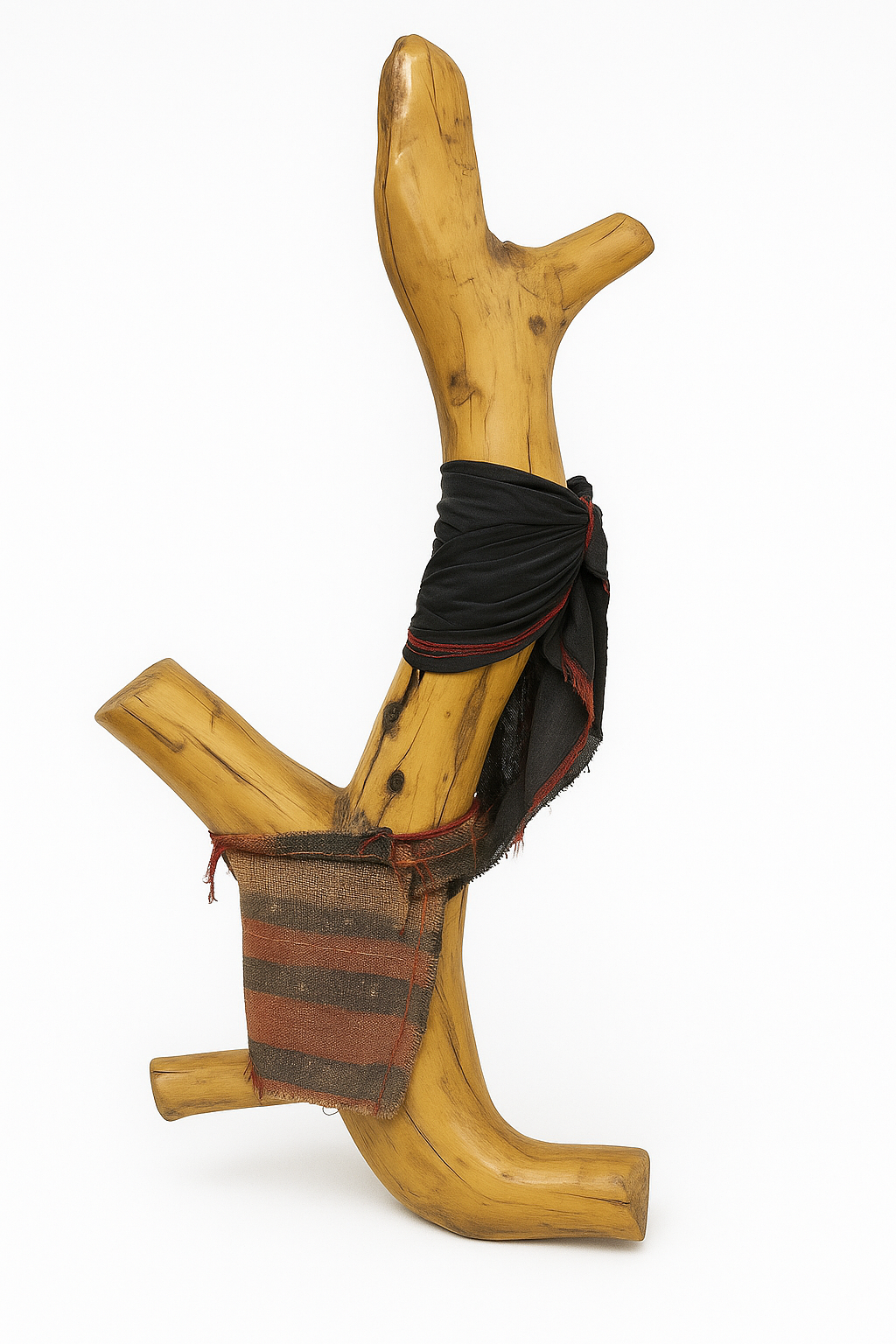
A rooted and upright form, cinched at its middle by a band from the past. The wood’s natural grain echoes the wear of time, while the traditional fabric carries ancestral and spiritual memory. This sculpture was not made to move, but to endure—to embody quiet resilience, deep patience, and continuity with the past.
Form and Structure
A vertical, rooted figure—simple and organic. At first glance, it stands still, unmoving, yet it carries within it the momentum of time and the weight of inherited history.
Its limbs—branch-like—do not stretch upward in yearning nor hang in surrender. They hold a balanced position, much like a patient soul standing through the passage of days.
The woven fabric wrapped around the center serves as a belt—not for adornment, but to preserve something internal, like a memory bound within the body.
Theme and Philosophical Lens
This sculpture speaks of patience that does not shout; of a culture that seems silent but lives and resists within.
The binding that holds the past challenges us to rethink endurance—not as stagnation, but as an active preservation of identity.
Here, Rafati transforms sculpture into a “body of memory”—a figure that remains standing because it still carries the weight of what came before.
Material and Technique
The natural lines and cracks in the wood reflect the mark of time and endurance.
The traditional textile is not merely decorative—it acts as a conduit for cultural emotion, echoing a vanishing or forgotten lifeway.
Rafati avoids exaggeration, letting the simplicity of the materials reveal the depth of meaning.
Emotional Impact
Despite its minimalism, the sculpture compels the viewer to pause.
It doesn’t scream or weep—but creates a quiet solidarity with what has been.
It invites us to stand with something that refuses to fade.
In this work, calmness becomes strength.
Conclusion
Held by the Past, Standing in the Present is a meditation on rootedness, memory, and the unpretentious majesty of patience.
Rather than reacting, it reminds—and in a world full of noise, that quiet remembrance becomes a powerful act of resistance.