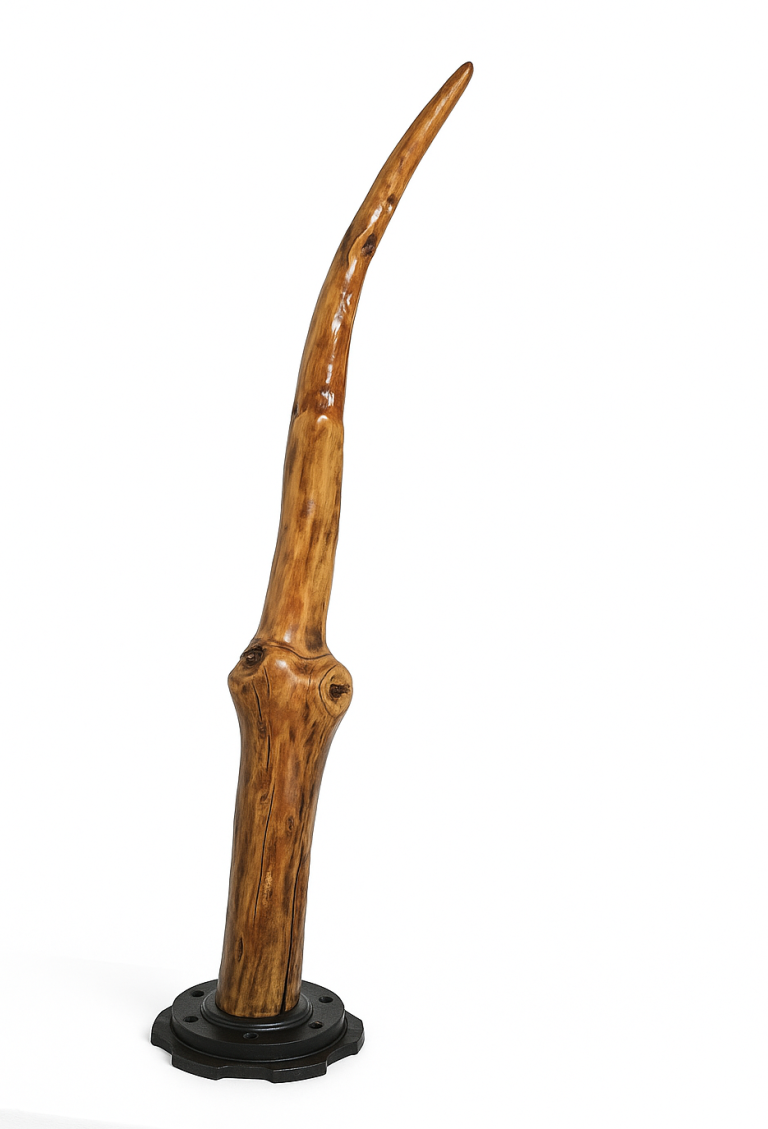
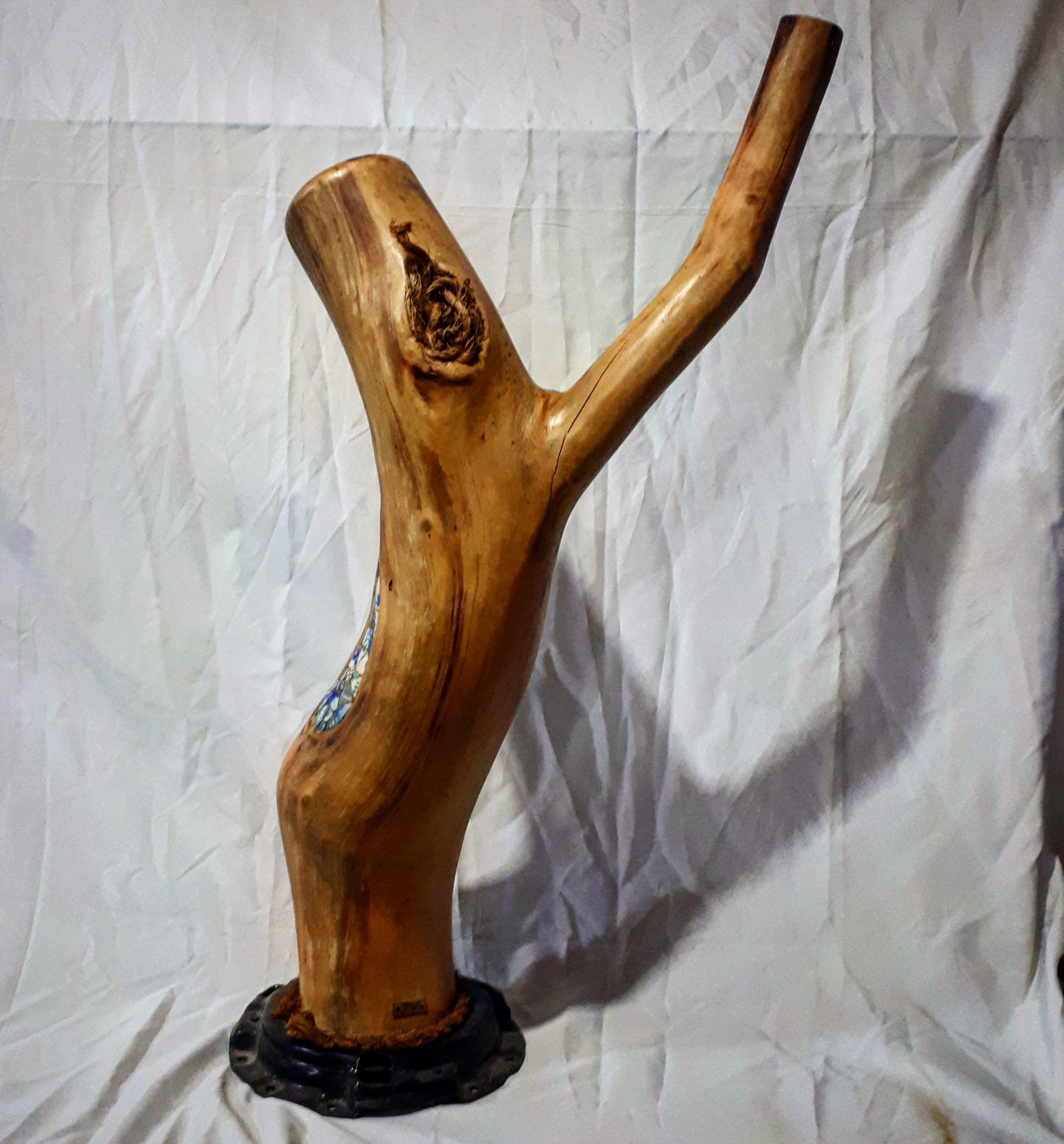
Description: An upright trunk with a raised but wounded arm. *Silent Uprising* embodies a human figure who has lost goodness, yet remains standing—not in surrender, but in protest. A voiceless cry that endures.
Form and Structure
Silent Uprising rises as a solitary trunk—natural, upright, and charged with silent tension. The wooden body curves upward, its outstretched arm not asking, but protesting. The form is neither passive nor aggressive; it exists in a state of restrained resistance.
A dark base holds the figure—part foundation, part shackle. A fractured tile embedded within the trunk suggests something once beautiful, now broken—echoing a goodness that has been taken, but not forgotten.
Theme and Philosophical Perspective
This sculpture is not about loud rebellion—it is about the quiet force of loss.
Silent Uprising embodies a human who has seen goodness fade, who bears scars of hope betrayed—yet still stands.
Rafati captures a protest not against systems, but against erosion: the erosion of kindness, truth, integrity. It is the kind of protest that does not break windows—but breaks hearts. A gesture of defiance, not in rage, but in witness.
Material and Technique
The use of natural wood, left largely unpolished, preserves the honesty of the material. The broken tile set into the surface is not ornamental—it is symbolic. It recalls a culture, a belief, a moment—lost but not erased.
The contrast between the raw wood and the structured metal base evokes a duality: the organic spirit resisting the rigidity of circumstance. The simplicity of construction is deceptive—there is depth in restraint.
Emotional Impact
This sculpture does not shout—it stands. And that standing, in its silence, is louder than protest.
It evokes a profound sadness: the kind of grief that does not scream, but refuses to kneel. It asks us:
Why do you still stand, if all has been taken?
And answers: Because something remains worth standing for.
There is pain here, but not despair. There is loss, but not surrender.
Conclusion
Silent Uprising is a portrait of resistance in its most dignified form. Not through action—but through presence.
A wound that refuses to close. A beauty that persists in fragments.
Rafati shows us that sometimes, the most powerful cry is not one we hear—
but the one we see, standing silently before us.